Related Posts Widget for Blogs by LinkWithin

Thursday, June 21, 2007

Vazhakkai Mezhukku Varatti

vazhakkai mezhukku varatti puli kari plantain indian easy recipe vegetarian


Vazhakkai is the Tamil word for Plantain. Green unripe plantain is something I grew up with - it was pretty much year round item and very common in Palakkad (Palghat) cuisine. It is usually cooked as a vegetable in mor-kozhambu and south Indian style curries.

One of my favorite curries is mezhukku varatti or upperi that my mom makes with plantain. The others include vazhakkai podimas (which is streamed and grated with coconut), vazhakkai pulikari (with tamarind), and as a prominent ingredient in avial (vegetable medley).

This recipe here is an adaptation of the mezhukku varatti and pulikari.

The specialty about this recipe that gives the texture i like is powdered par-boiled rice that has been lightly toasted first before powdering. And of course, the tang from the tamarind. Plus, I like to add coarse crumbled toasted peanuts, and some dry grated coconut...

vazhakkai mezhukku varatti puli kari plantain indian easy recipe vegetarian


Ingredients:
2 plantains
2 Tbsp tamarind concentrate (adjust to taste)
2 Tbsp chili powder
1 tsp turmeric powder
1 Tbsp brown sugar
3 Tbsp dry grated coconut
3 Tbsp coarsely ground toasted peanuts
2 Tbsp par-boiled rice (or jasmine rice), dry toasted and coarsely ground
water as needed
salt to taste

Tempering: 1 tsp coconut oil or canola oil, 1 tsp mustard seeds, 1 tsp cumin seeds, 1 tsp urad dal, 1 tsp chana dal, 4-6 curry leaves (optional)

Preparation:

peel the plantain with a vegetable peeler, and dice it; keep it in a bowl of water till ready to throw in the pan for cooking

mix the coarsely ground dry roasted rice, dry grated coconut and coarsely ground toasted peanuts and keep handy

tempering: heat oil in a pan, when shimmering add the chana dal, when it turns golden brown add the urad dal, when it turns golden brown add the mustard seeds, and when they pop add the cumin seeds and curry leaves

then add the plantain some salt, turmeric, chili powder, tamarind concentrate, brown sugar, some water, stir well, cover and cook till plantain is tender and cooked; adjust flavors to taste

stir in the rice+peanuts+coconut powder mix and stir it in; the cool thing about this is it absorbs any extra water and makes the dish come together with a wonderful texture - not too dry, not too runny

I had some spring onions in the garden that I used for garnish, but, curry leaves, or cilantro leaves or even sliced green chilies is a good garnish for this recipe.

Serve warm with rice and rasam or sambar. I like it better with hot rotis :-)

This Vazhakkai mezhukku varatti style recipe is my 'V' dish for lovely Nupur's A to Z of Indian Vegetables event.

azhakkai mezhukku varatti puli kari plantain indian easy recipe vegetarian

Labels: , , , , ,

Friday, June 08, 2007

Taro root: grated and pan-fried

Taro-Root-pan-fried-1


Taro root, while not quite the substitute for potatoes, usually lends itself to be cooked up like potatoes. This is a very simple recipe, similar to my old Chaembu recipe, but, this time I decided to grate it, just like for hashbrowns. Except, I wanted it rather flaky and crispy all over, not lumped inside and crispy outside like hashbrowns ...

Ingredients: taro root, salt, chili powder; tempering: 1-2 Tbsp oil, 1 tsp mustard seeds, 1 tsp cumin seeds

Peel the skin and grate the taro root. Heat oil in a pan, add the tempering - when mustard seeds pop, add the cumin seeds, then add the grated taro root and toss it around to coat in oil well. I usually don't add any water as it tends to clump up. Add salt and chili powder. Keep stirring like for scrambled eggs over medium high heat till taro root is cooked and crisped. Serve warm with rasam and rice.


This Taro root, grated and pan-fried, is my 'T' dish for lovely Nupur's A to Z of Indian Vegetables event.

Labels: , , ,

Wednesday, May 30, 2007

snake gourd and brown lentils

snake gourd brown lentile indian vegetarian

Snake gourd (Trichosanthes cucumerina) intrigued me as a child - its shape and color, its soft spongy core, its hollow inside, its resemblance to bitter gourd... the only other vegetable that intrigued me equally when I was growing up was the Moringa (aka drumstick, murungakai).

My mom usually made koottu, molagoottal, or poduthuval out of snake gourd. It struck me as bland and tasteless, almost watery. And if not picked tender and cooked right away, they tend to become woody/chewy and rather unpalatable. The seeds and pulp inside are bitter. And, many a times, the flesh also happens to be bitter.

If buying fresh snake gourd, I usually try to taste a tiny bit before cooking and serving. They are also available frozen. So far, the frozen ones have turned out better tasting than the fresh ones I have used. Possibly because they are picked tender and frozen right away whereas the fresh ones travel a long way to reach my local produce market...

My preferred way to cook snake gourd so far has been to sauté it with some salt and turmeric powder, add some tempering and some grated coconut, and serve it light and simple with some rice and rasam or sambar. Every once in a while, I like to throw in some lentils to up the nutritional value, as in this recipe.

Ingredients
1 pkt frozen, sliced snake gourd
1 cup brown lentils, soaked overnight
¼ cup grated coconut
1-2 green chilies
½ tsp turmeric powder
1 tsp Madras curry powder
salt to taste
Tempering: 1 Tbsp canola oil, 1 tsp mustard seeds, 1 tsp cumin seeds, 1 tsp urad dal, 3-4 curry leaves

Preparation

cook the brown lentils till soft and tender but not mushy

coarsely blend the coconut and green chilies and keep handy

tempering: heat oil in a pan, when shimmering add the urad dal, when it turns golden brown, add the mustard seeds and when they pop add the cumin seeds and curry leaves, then add the turmeric powder and curry powder, stir a little to let the spices bloom

add the frozen snake gourd, cooked brown lentils, salt to taste, sauté a bit, cover and let the snake gourd cook till tender but not mushy; stir in the coconut-green-chili mixture

This Snake Gourd & Brown Lentils is my 'S' dish for lovely Nupur's A to Z of Indian Vegetables event.

Labels: , , , , ,

Thursday, May 10, 2007

Pan Fried Pavakkai Bitter gourd

easy recipe pan fried pavakkai bitter melon indian vegetarian asian cuisine

Pavakkai is bitter gourd, in Tamil. It used to be one of my least favorite ones despite my dad extolling its virtues (antido­tal, antipyretic tonic, appetizing, stomachic, antibilious and laxative) in the health department. Not sure when exactly it happened, but around the time I "grew up", I started appreciating pavakkai more, and these days am so glad D loves it too, so I get to make it as often as I want :)

Bitter gourd, or bitter melon, that I have used so far are of two types:
1. small, dark green with pronounced ridges and bitterness
2. larger, light green, relatively smooth skin and mildly bitter

I cook each in different ways - the smaller one is good for stuffing and frying, the bigger one is good in sambar or pan-fried as a side dish in this recipe. The pronounced bitterness doesn't blend well with other vegetables to my liking.

pavakkai-1


Ingredients
1 - 2 large green bitter melon (Fu Gwa)
2 - 3 Tbsp canola oil
1 Tbsp dry red chili powder
1 Tbsp coriander powder
1 tsp turmeric powder
1 tsp brown sugar
1 Tbsp lemon juice
salt to taste

tempering: 1 Tbsp canola oil, 1 tsp mustard seeds, 1 tsp cumin seeds, 3-4 curry leaves

Preparation

chop the ends off, scoop out the innards* and slice the pavakkai into rings; salt it and let it sit for about 10 minutes; drain, pat dry
*If it helps, here's how I usually do it: I cut them into roughly 3-inch pieces, and insert my vegetable peeler or a spoon into the central pulp and rotate it like I am juicing a lemon, trying not to tear the flesh apart to scoop out the innards:)

tempering: heat oil in a pan, when shimmering add the mustard seeds and when they pop add the cumin seeds and curry leaves, then add the powdered spices, stir a little to let the spices bloom

add the sliced pavakkai, brown sugar, some salt, a few tablespoons of water, cover and let it sweat and cook a little; then remove the lid, turn up the heat and pan fry till done, adding a little more oil if needed; off heat stir in lemon juice

Serve warm with basmati rice and ghee, or rasam, or mor-kozhambu.

This Pan-fried Pavakkai is my 'P' dish for lovely Nupur's A to Z of Indian Vegetables event.

Labels: , , ,

Tuesday, May 01, 2007

Opo Squash Mor-Kozhambu


Opo Squash (Pul Qua, Hu Lu Gua, Woo-Lo-Kua, Peh-Poh, Long Squash/Melon) is mostly bland and watery, so, it works well with a lot of Indian recipes which have interesting spices.

Mor-Kozhambu is a buttermilk/yogurt based dish, usually served with rice, and accompanied by some poduthuval or paruppusili. But, I like to eat a bowlful of cool mor-kozhambu as a summer soup sometimes :)


Ingredients
½ medium opo squash, peeled and diced
1 medium carrot, chopped
1 medium onion, chopped
1 cup buttermilk
1½ cups plain yogurt
¼ tsp turmeric powder
salt to taste
water as needed

cliantro for garnish

tempering: 1 tsp oil, 1 tsp mustard seeds, 1 tsp cumin seeds, 3-4 curry leaves

for the spice paste:
½ cup dry (or fresh) grated coconut
2-3 jalapeños or green chilies
2 Tbsp grated ginger

Preparation

combine the spice paste ingredients in a blender or food processor and blend to a smooth paste; keep handy

place the opo squash, onions, carrots, some salt, turmeric powder in a pan, add just enough water, cover and cook the vegetables

turn down the heat, add the spice paste, stir well, then fold in the yogurt and the buttermilk, and heat through gently till well combined; turn off heat - buttermilk will separate if cooked for too long; garnish with tempering and cilantro

tempering: heat oil in a pan, when shimmering add the mustard seeds and when they pop add the cumin seeds and curry leaves, turn off heat

Serve warm or at room temperature with rice.

This Opo Squash Mor-Kozhambu is my 'O' dish for lovely Nupur's A to Z of Indian Vegetables event.

Labels: , , , ,

Tuesday, April 24, 2007

Navy Beans poduthuval

easy recipe navy beans palakkad palghat poduthuval indian vegetarian

Navy beans is versatile. I usually soak and cook up a large batch, freeze them, and conveniently forget about them :)

A handful in soups and stews, a cup or two mixed in with vegetable pulao, or cooked as in this poduthuval recipe here to be eaten as a snack, salad or a side, navy beans feels wholesome.

I like the navy beans to be cooked through, soft, but not mushy - still holds shape.

Poduthuval is a term I have heard my dad and grandpa use. I just use the term "curry" for everything - with gravy or dry as in this recipe :) I am not sure of the origin of the term, but, it fits the characteristics of this navy beans recipe here - dry spice powder (usually with coconut) used to flavor vegetables in Palakkad recipes my mom taught me.

Ingredients
1 cup cooked navy beans
1 cup frozen peas
½ medium onion finely diced
1 Tbsp grated ginger
1 tsp brown sugar
salt to taste

tempering: 1 tsp oil, 1 tsp mustard seeds, 1 tsp cumin seeds, 4-6 curry leaves

for the spice powder:
¼ cup grated coconut
¼ cup coriander seeds
3 Tbsp chana dal
1 Tbsp urad dal
4-5 dry red chilies


Preparation

toast the spice powder ingredients till aromatic, and grind to a fine powder, no water needed

tempering: heat oil in a pan, when shimmering add the mustard seeds and when they pop add the cumin seeds and curry leaves; throw in the onions and ginger, a pinch of salt, and sauté till onion turns translucent

add the navy beans, frozen peas, brown sugar and the spice powder, stir well, cover and cook till peas are soft; adjust salt to taste

Serve warm as a side with rice and sambar, or rice and mor-kozhambu, or just eat it as-is, like a salad, which is what I prefer :)

This Navy beans poduthuval is my 'N' dish for lovely Nupur's A to Z of Indian Vegetables event.

Labels: , , ,

Tuesday, April 17, 2007

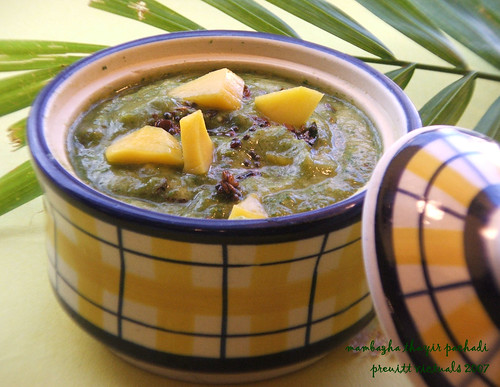
Mango Pachadi

mambazham mango pachadi chutney indian a to z of indian vegetables

Pachadi is a south indian side which can either be yogurt-based or tamarind-based. It is usually sweet-sour if made with tamarind, and cool-bland if made with yogurt.

I like unripe green mango as much as juicy sweet mango fruit. This mango pachadi recipe is not quite traditional. Driven by my usual spirit of experimentation, and, not finding all the traditional ingredients handy, I ventured to come up with a rather unusual and yet surprisingly tasty pachadi :)

As always, taste is very personal, so, the ingredients and quantities can be adjusted to your liking. The tang from the vinegar in the pickled jalapeño and the smoky heat from the ancho-pasilla chilies combined with the mild sweetness of the mango made this dish quite interesting for me.

Ingredients
1 large ripe mango
1 Tbsp fresh grated ginger
6 rings/slices of pickled jalapeño
2 dried ancho-pasilla chilies, reconstituted
1 cup chopped cilantro leaves
¼ cup plain yogurt
salt to taste

tempering: 1 tsp oil, 1 tsp urad dal, 1 tsp mustard seeds

partially peel the skin, remove the seed and coarsely chop the mango; remove the skin completely if preferred - i like the texture and taste the skin adds

combine all the ingredients except yogurt in a blender or food processor and blend to a smooth paste; fold in the yogurt gently, adjust flavors to taste; garnish with tempering

tempering: heat oil in a pan, when shimmering add the urad dal and when it turns golden brown add the mustard seeds and when they pop turn off heat

Serve at room temperature with rice and molagoottal, or dosai, even with simple roti.

This Mango pachadi is my 'M' dish for lovely Nupur's A to Z of Indian Vegetables event.

Labels: , , , , ,

Wednesday, April 11, 2007

lemon rice

A to Z of Indian vegetables event easy recipe lemon turmeric rice indian cuisine

Whether taking the G.T Express, or the Bangalore Mail, or the Charminar, as a little kid in India, one thing that still lingers in my mind is the food my mom used to pack for the trip. Hearty, simple, sturdy idlees, fortified and enhanced yogurt rice plus good old Lemon Rice.

And Lemon Rice is my 'L' post for lovely Nupur's A to Z of Indian Vegetables event.

This is a very simple dish that is easy to throw together with leftover plain cooked rice, if handy; and, has always withstood the scorching heat during our train rides without spoiling - thanks to the lemon juice that provides enough acidity to keep this for a few days.

Ingredients
3 cups cooked basmati rice
1 medium onion diced finely
1-2 serrano chilies chopped finely
1-2 Tbsp grated ginger
1 tsp turmeric powder
1 tsp brown sugar
4-5 curry leaves (optional)
salt to taste
4 Tbsp lemon juice
Tempering: 1 Tbsp canola oil, 1 tsp chana dal, 1 tsp urad dal, 1 tsp mustard seeds

garnish: toasted cashew nuts, toasted peanuts

Preparation

tempering: heat oil in a pan, when shimmering, add the chana dal, when it turns golden brown add the urad dal, and when urad turns light brown add the mustard seeds, and when they pop add the curry leaves, ginger, chilies, turmeric, onion, a pinch of salt and brown sugar, and sauté till onions turn translucent

stir in the rice till well incorporated; off heat, stir in the lemon juice; garnish with toasted peanuts and/or cashew nuts

preferably, add a little lemon juice at a time, stir well, taste and add more to suit your taste - i like it mildly tangy, not too strong:)

Serve warm or at room temperature, with pappadam or favorite chips.

Labels: , , , ,

Tuesday, April 03, 2007

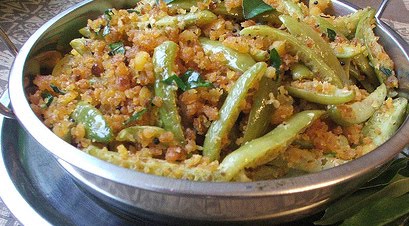
kovakkai paruppusili

easy recipe tindora kovakkai lentils paruppusili


Coccinia grandis, Tindora, Kovakkai, Dondakaya, Ivy Gourd... whatever we call it, this is  one of my childhood favorites.

I don't make it often these days - it depends on whether my local Indian stores carry it when I feel like having some, but, as it happened, D bought a pound of Kovakkai recently that I eagerly cooked up into my favorite dish here.

easy recipe tindora kovakkai lentils paruppusili

Paruppusili is basically, red gram lentils soaked with some dry red chilies, ground into a paste, steam-cooked and then pan fried and added to vegetable of choice, which in this recipe happens to be Kovakkai. The procedure is the same as my Green Beans Paruppusili recipe.

easy recipe tindora kovakkai lentils paruppusili

After soaking and grinding the red gram lentils (toor dal, tuvar dal), I like to shape it into small balls and steam the lentil balls. At this point, the steamed lentil balls can be frozen for future use - just thaw in microwave on low power as needed. The lentil balls can also be used to make a wonderful dish we relish in my family, called Paruppu Urundai Kozhambu.

Ingredients:
4 2"-diameter steamed lentil balls, if handy
OR
(1 cup toor dal, 2 dry red chilies, some water)
------------

1 pound kovakkai*, cut length-wise
salt to taste
* I prefer the green and unripe Kovakkai for this dish, not the ripe ones that are reddish inside

tempering: 2 Tbsp oil, 1 tsp mustard seeds, 1tsp cumin seeds, few curry leaves

Preparation:

to make lentil balls: soak the toor dal and dry red chilies in water for about an hour or two; drain, grind it to a thick paste; shape into 2" diameter balls; steam them and set aside

steam the kovakkai with a pinch of salt till cooked through but not mushy, drain, and set aside

heat oil in a non-stick pan, add the tempering: when mustard seeds pop and die down, add the cumin seeds and curry leaves, crumble the lentil balls and add them to the pan; stir fry till the lentils get slightly crispy and golden

add the steamed kovakkai to the pan, stir till well incorporated; adjust salt to taste

Serve warm with simple roti, or, with basmati rice and pepper rasam

This Kovakkai paruppusili recipe is my 'K' dish for A to Z of Indian Vegetables event hosted by Nupur of One Hot Stove. It takes hard work to do the round-up week after week and I really appreciate all the effort Nupur has been putting into hosting this event.

Labels: , , , , , ,

Wednesday, March 28, 2007

javvarisi upma

easy recipe tapioca pearls vegetable upma sabu dana javvarisi
Javvarisi (aka sabu dana, sago) is tapioca pearls made from cassava/yuca roots. It was not my favorite when I was little: as tapioca pearls are very starchy and turn translucent when cooked, my young mind likened it to snot :-)

But, I have started appreciating it more these days... especially since I am eager to introduce my wee one to new foods as she is growing up.

The most common way my mom used to cook these up is a dessert/sweet dish called paisam where the tapioca pearls are cooked in milk and sugar till translucent.

Here, in this recipe, I just make a simple vegetable kichdi-style upma-of-sorts out of javvarisi, flavored by ginger, onions, turmeric and salt. I find the smell of ginger and onion sautéing with a pinch of turmeric and salt very appetizing :-)

Ingredients:

1 cup javvarisi/tapioca pearls
1 medium potato, peeled, cooked, crumbled
½ cup frozen peas
½ cup frozen corn kernels
½ medium onion, diced finely
1-2 chilies, diced finely
2 Tbsp freshly grated ginger
1 tsp turmeric powder
salt to taste
cilantro for garnish

tempering: 1 Tbsp oil, 1 tsp mustard seeds, 1 tsp split urad dal, 1 tsp cumin seeds, some curry leaves (optional)

Preparation

soak the javvarisi in 6 cups of water overnight or longer; usually, i like to soak it tonight and cook it for dinner tomorrow night

drain the soaked javvarisi well and pat dry if needed, keep handy

tempering: heat oil in a pan, add the urad dal and when it turns golden brown, add the mustard seeds, and when they start to pop, add the cumin seeds and curry leaves; then add the onions, chilies, turmeric powder and ginger, with a pinch of salt and sauté till onions turn translucent

add the frozen peas, corn kernels, and the cooked-and-crumbled potatoes, sauté for a bit longer

add the soaked and drained javvarisi and cook till the tapioca pearls turn translucent (if soaked well, it only takes a few minutes for the tapioca pearls to turn translucent); also, they tend to clump up, so, try to stir it on and off to keep the pearls separate

off heat, garnish with cilantro and serve warm

Labels: , , , ,

Friday, March 23, 2007

Idi Chakkai


Idi Chakkai is a comfort food for me, with pepper rasam and pain hot rice. Idi Chakkai feels wholesome, yet simple. It is made with young green jackfruit. My mom only made it a few times a year, around The Jackfruit Season, as it was labor-intensive to chop, clean and pound the green jackfruit.

(probably where the name of this dish comes from: Idi is to pound, and Chakkai is jackfruit => pounded jackfruit)

But now that canned young green jackfruit is readily available year-round, this recipe takes less than 10 minutes to put together, and uses just 4 ingredients in its simplest form - green jackfruit, coconut, chilies, salt.

Tempering is optional, and adds a nice touch to this simple dish.

Nendran Pazham is a variety of plantain/banana that happens to be my favorite. I haven't found it here yet. But, Burro Bananas, when ripe, get a similar texture, smell and color like nendran, even though they taste a little different and are much smaller in size compared to the nendrans I used to relish.

To add a simple dessert, boil the burro bananas (skin on), in some water mixed with brown sugar, till it is soft but not mushy; then, peel the cooked banana and enjoy as a dessert. This is basically the same procedure my mom used to cook nendran pazham and serve it up as snack or dessert for us when we were little.

Ingredients:
2 cans young green jackfruit, (comes packed in water), drained
¼ cup dry grated coconut
1 jalapeño, chopped
salt to taste
6-8 curry leaves (optional)
tempering: 1 Tbsp canola oil, 1 tsp urad dal, 1 tsp mustard seeds, 1 tsp cumin seeds

Preparation

combine the young green jackfruit chunks and jalapeño in a blender or food processor and pulse a little - just to break them down a little, not too fine

tempering: heat oil in a pan, add the urad dal, when it turns golden brown add the mustard seeds and when they pop add the cumin seeds and let them plump up a little; turn down heat so as not to burn the urad dal; add the curry leaves

add the green jackfruit and jalapeño mixture, dry grated coconut, some salt to taste and stir well; cook over medium heat, stirring on and off till well-combined

Serve warm with simple roti, or, rice and pepper rasam.


Even though this dish leaves very little room for variations, this recipe here is just a tad different from the last time I made it about 3 months ago. This is my 'I' dish for Nupur's A to Z of Indian Vegetables event.


p.s: Following a note from Nupur, I just wanted to add that canned young green jackfruit I use is available at most Asian stores in my area - perhaps it is available in Indian stores as well, am not sure.

Labels: , , , , , , , ,

Thursday, March 15, 2007

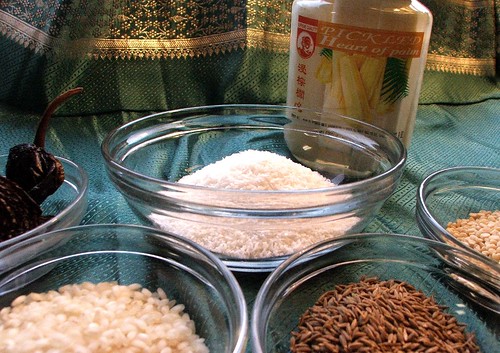
Heart of palm Molagoottal

easy recipe milagoottal molagoottal heart of palm
Molagoottal (milagu kootal, milagoottal) is a south indian dish which my mom usually makes with bland vegetables like chayote squash or cabbage or spinach.It is pretty mild, with just a few dry red chilies bringing in some heat. Typically it is accompanied by a sweet-and-sour dish called Pachadi, usually made with pumpkin or eggplant or okra.

Vaazha Thandu is a specialty item (not sure if it classifies as a "vegetable") - a thing i haven't had in decades - roughly translates to "banana plant stem": That is really what it is :-)

After peeling away the outer fibrous layers, the inner part of the stem - the "cylindrical core" is softer and has a wonderful texture when cooked into koottu or even milagoottal or pachadi.

The main objection my mom has to making this often is the labor involved in "cleaning" it up for consumption - removing the fibers and chopping them finely.

I was craving for some vaazha thandu, but, i haven't been able to find any around here. So, i decided to try Heart of Palm, as a substitute:
When harvesting the cultivated young palm, the tree is cut down and the bark is removed leaving layers of white fibers around a center core. During processing the fibers are removed leaving the center core or heart of palm. The center core is attached to a slightly more fibrous cylindrical base with a larger diameter. The entire cylindrical center core and the attached base are edible. The center core is considered more of a delicacy because of its lower fiber content.
I found some heart of palm at the asian supermarket nearby. It comes canned, usually in water, with some citric acid for preserving. I was curious about how good a substitute it will be for vaazha thandu, and decided to find out.

Molagoottal is a simple dish with a spice paste using coconut, and some cooked toor (tuvar, split red gram/lentil) dal and a suitable vegetable. I get excited about fusion cooking and experimenting, so, instead of traditional dry red chilies, I decided to use ancho-pasilla dry red chilies - just soaked them in some hot water to reconstitute them a little before making the paste.

easy recipe milagoottal molagoottal heart of palmIngredients:
1 can heart of palm, drained, diced
1 cup cooked toor dal (split red gram/lentil), mashed
water as needed
salt to taste
2 Tbsp canola oil

for the molagoottal paste:
½ cup dry grated coconut
1-2 ancho pasilla chilies, reconstituted in hot water
2 Tbsp urad dal
1 Tbsp par-boiled rice (or jasmine rice)
1 Tbsp cumin seeds

tempering: ½ tsp mustard seeds, 1-2 curry leaves, chopped, ¼ tsp asafoetida powder, 1 tsp canola oil

Preparation

heat 1 tsp oil in a pan, add urad dal, rice and cumin seeds and toast till urad dal is fragrant and light brown; remove from heat; allow to cool; combine with the rest of the molagoottal paste ingredients and grind to a fine paste

heat 1 Tbsp oil in a pan, add the heart of palm and sauté a bit; then add the molagoottal paste, cooked toor dal, some salt, some water, and let it simmer gently on medium low heat till the flavors have come together, stir on and off

meanwhile, get the tempering ready:in a separate pan, heat the oil, add the mustard seeds, when it pops, add the curry leaves and asafoetida and turn off heat

when molagoottal is ready, garnish with the tempering, serve warm with rice

optionally, serve with smoked eggplant pachadi

Heart of Palm is fairly new to me and this is the first time I am using it in this sort of experimental fusion cooking, instead of in tried-tested recipes. It is clearly not the same as vaazha thandu, but, it is quite interesting in this recipe nonetheless. Will I use it again? Of course! I am already searching for some Costa Rican recipes to use it in...

And, the ancho-pasilla chilies gave a beautiful smoky flavor, plus a rich deep color to the molagoottal. Not the traditional molagoottal my mom makes, but, I am sure she will like it nonetheless when i make it for her next time :-)

Nupur at OneHotStove is hosting an A to Z Indian vegetables event, which is pretty exciting and this is my experiment with 'H' for this week :-)

Labels: , , , , ,

‹Older